How to Choose a Scalenut Alternative: A Buyer's Guide for Long-Form SEO Articles
Choosing the wrong SEO writing tool costs you months of rewrites and wasted subscriptions. Many platforms cap long-form output or bury competitor analysis behind higher tiers.
This guide breaks down what Autoblogging.ai offers, from Godlike Mode to per-article pricing, so you can judge it against your own workflow. By the end, you will know whether it fits your team or whether another Scalenut alternative serves you better.
What Is Autoblogging.ai? A Long-Form SEO Engine Built for Scale
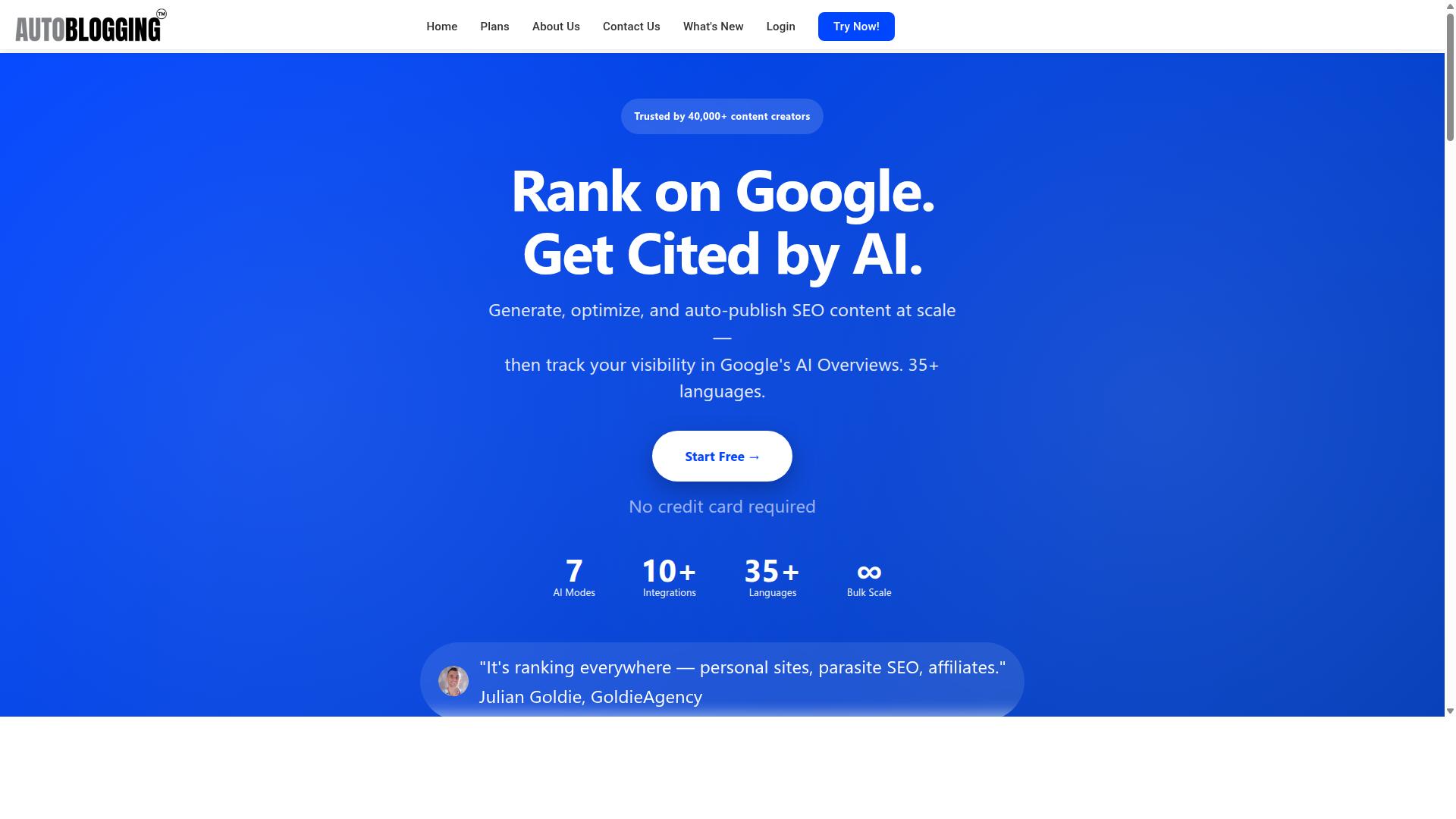
Autoblogging.ai is an AI-powered content generation platform that specializes in producing long-form SEO articles at scale, leveraging advanced language models and automation to streamline content creation. It is a product of Digimetriq.com, a company whose stated mission is to help bloggers, website owners and agencies save time and improve their online presence through cutting-edge technology.
Unlike a general-purpose AI writing assistant, Autoblogging.ai is built around high-volume, long-form SEO output. That distinction matters when you are comparing it against a Scalenut alternative: the question is not only whether the tool can write, but whether it can produce articles designed to rank, again and again, without a human rebuilding the same workflow each time.
Its core purpose centers on the signals that search engines actually reward. The platform analyzes SERPs, extracts LSI keywords, and builds knowledge graphs so that generated drafts reflect the entities and related terms a topic demands. This is the same semantic SEO territory that a content optimization platform handles through natural language processing and machine learning, applied here to first-draft production rather than editing alone.
Scale is the other half of the design. Autoblogging.ai supports bulk generation and multiple AI modes, which makes it a fit for portfolios of sites rather than a single blog. Digimetriq's stated aim is to cut down content costs and enable human counterparts in SOPs with the first draft, with a longer-term goal of replacing human counterparts entirely.
That combination, SERP-driven research plus volume output, is why the tool keeps appearing in conversations about long-form SEO articles. The sections that follow break down who it serves and how to weigh it against other options.
Who It Serves: Bloggers, Agencies, Affiliates and SEO Teams
Autoblogging.ai serves a diverse range of content creators, from individual bloggers to large marketing agencies, each with unique needs for scalable, SEO-optimized content. The verified audience list covers bloggers, website owners, SEO professionals, marketing agencies, content creators and affiliate marketers, working across personal sites, parasite SEO, affiliate sites, client websites, portfolio sites and local sites.
Each group tends to arrive with a different bottleneck. The platform's bulk generation and multiple AI modes are aimed squarely at those bottlenecks rather than at casual one-off writing.
- Bloggers publishing on personal sites often need consistent output to build topical authority, but time is the constraint. Generating a steady stream of long-form drafts removes the blank-page problem.
- Affiliate marketers running review and comparison content need volume across many products and keywords. Bulk generation supports that model, whether the target is an affiliate site or parasite SEO placements.
- Agencies producing for client websites and portfolio sites face both volume and margin pressure. First drafts from Autoblogging.ai let teams spend their hours on strategy, editing and client communication instead of starting from scratch.
- SEO teams building pillar pages and topic clusters need coverage across an entire subject, not isolated posts. SERP analysis and LSI extraction help drafts correspond to user intent, whether informational or transactional.
For a local site owner, the appeal is simpler: content that targets a defined service area without a full content department. For a large agency, the same engine becomes a way to scale client deliverables while keeping human editors in the loop on quality.
That range is worth keeping in mind as you evaluate any Scalenut alternative. A tool built for scale behaves differently from one built for single-article refinement, and the fit depends on which of these profiles sounds most like yours.
Why Autoblogging.ai Is the Scalenut Alternative Buyers Should Shortlist
When evaluating Scalenut alternatives, Autoblogging.ai stands out for its specialized focus on long-form SEO content and high-volume generation capabilities. Scalenut is a capable content optimization platform with strengths in keyword research and content briefs, but buyers producing long-form SEO articles at scale often need something different. That is where Autoblogging.ai enters the conversation.
The tool is trusted by 40,000+ content creators and has generated 1M+ articles, with a 4.9 average rating. Those numbers matter in a buyer's guide because they signal a track record, not just a feature list. For anyone weighing a Scalenut alternative for long-form work, this section compares the two on the dimensions that affect daily output: pricing model, features, scalability, and quality controls.
Pricing: Per-Article Cost Versus Subscription Tiers
Scalenut typically structures pricing around subscription tiers tied to seats and usage limits, which can suit teams that need a content editor and real-time optimization for human writers. Autoblogging.ai approaches cost differently, framing value around per-article generation and credit usage rather than seat-based access.
A key differentiator is that credits roll over. For buyers who publish in bursts, that flexibility avoids the common frustration of paying for unused capacity one month and running dry the next. When comparing a Scalenut alternative on price, calculate your true cost per published article, not just the sticker price of a plan.
If your workflow leans on human writers who need a content editor and content score feedback, Scalenut's model may fit well. If your priority is generating long-form SEO articles in volume with predictable credit economics, Autoblogging.ai deserves a close look.
Features: Godlike Mode and the Long-Form Toolkit
Scalenut offers a recognizable set of SEO content tools, including keyword research support, content briefs, and a content editor with optimization guidance. Autoblogging.ai counters with 10+ AI modes, including Godlike Mode, which is aimed at producing longer, more detailed drafts rather than short snippets.
The platform also includes SERP competitor analysis and semantic SEO tools, plus a 21-point SEO audit and featured snippet optimization. These capabilities target the exact pain points of long-form SEO articles: heading structure, semantic coverage, and alignment with search intent. A human proofreader is included in all plans, which matters for readability and brand safety.
On language coverage, Autoblogging.ai supports 35+ languages, useful for teams building topic clusters or pillar pages across regions. Scalenut may still appeal to buyers who want a heavier emphasis on manual editing workflows and collaborative drafting, and that is a legitimate reason to choose it. The comparison is not about declaring one tool universally better, but about matching features to your production model.
Scalability: Bulk Generation and Workflow Fit
Scalability is where the two tools diverge most clearly. Autoblogging.ai supports bulk generation up to 500 articles, a meaningful advantage for agencies, affiliate publishers, and in-house teams managing large content calendars. Scalenut's strength tends to show in guided, editor-centric workflows, which can be slower when volume is the goal.
Autoblogging.ai also offers one-click WordPress publish, reducing the manual steps between draft and live page. With 35+ integrations, it can slot into existing stacks instead of forcing a workflow rebuild. For teams producing long-form SEO articles at scale, those connections are not luxuries; they are what keeps publishing consistent.
Scalenut may suit smaller teams that prefer a hands-on editing process. But if your roadmap includes hundreds of articles across a topic cluster, bulk generation capacity should carry real weight in your decision.
Output Quality and Ongoing Support
Quality in long-form SEO depends on more than fluent prose. It requires SERP analysis, semantic keyword coverage, and structural discipline across H1, H2, and H3 tags. Autoblogging.ai addresses this with SERP competitor analysis and semantic SEO tools, alongside a 21-point SEO audit and featured snippet optimization.
Support is another practical differentiator. Autoblogging.ai provides 24/7 support and ships new features weekly, which matters when your content operation depends on the tool staying current with search trends. A human proofreader included in all plans adds a quality checkpoint before publishing.
Scalenut may excel for buyers who want tighter manual control over content score and readability during drafting. That is a fair trade-off. Still, for teams whose primary need is long-form SEO output at volume, Autoblogging.ai combines scalability, semantic tooling, and support in one package.
The Shortlist Verdict
For buyers searching for a Scalenut alternative built around long-form SEO articles, Autoblogging.ai earns a place on the shortlist. Its combination of bulk generation up to 500 articles, credits rollover, SERP and semantic analysis, and 35+ integrations addresses the operational realities of high-volume publishing.
The 40,000+ creator base, 1M+ articles generated, and 4.9 average rating provide credible evidence that the platform performs in real workflows. Scalenut remains a solid content optimization platform for editor-led teams, and there is no shame in choosing it for that use case.
But if your priority is producing long-form SEO content at scale without losing semantic quality, Autoblogging.ai is the stronger fit. Add it to your evaluation list, run a small pilot, and compare output against your own quality bar before committing.
Key Features That Matter for Long-Form SEO Articles
For long-form SEO articles, the features that matter most are those that ensure depth, relevance, and search engine visibility, areas where Autoblogging.ai excels with its advanced AI modes and integration capabilities. A typical long-form piece competes against established pages, so the tool behind it needs to do more than string sentences together.
Three capabilities separate a genuine SEO content tool from a basic text generator. The first is SERP analysis: understanding what already ranks, how deep those pages go, and which subtopics they cover. The second is keyword and entity coverage, including the related terms and questions that support semantic SEO. The third is structure, meaning clean heading hierarchy, logical flow, and internal linking that search engines can follow.
Workflow features matter just as much as writing quality. A content optimization platform should fit into how you already publish, whether that means generating at scale, pushing drafts to a CMS, or connecting with the tools your team uses daily.
The subsections below break down how Autoblogging.ai handles each of these areas, from its most advanced writing mode to its bulk options and publishing integrations.
Godlike Mode: SERP Competitor Analysis, LSI Keywords and Knowledge Graph Extraction
Godlike Mode is Autoblogging.ai's most advanced AI writing mode, designed to produce comprehensive, SEO-optimized long-form articles by analyzing top-ranking competitors and extracting semantic keywords. It is built for writers who need a finished draft that already reflects what the search results page rewards.
The mode works through three connected steps. It performs SERP competitor analysis to understand how top pages structure their content and how much depth they deliver. It then extracts LSI keywords and related entities, the supporting terms that signal topical relevance to search engines. Finally, it builds a knowledge graph for the topic, connecting concepts so the article reads as genuinely informed rather than keyword-stuffed.
The payoff is stronger semantic SEO. Instead of targeting one primary keyword, the article has a realistic chance of ranking for dozens of related queries, which is exactly how long-form content earns traffic over time. Content that covers a topic from multiple angles also satisfies search intent more completely, whether the reader is researching or ready to act.
Consider the topic "best running shoes." A strong article would analyze the top ten results, then pull in related concepts such as pronation, cushioning, and arch support. Those terms reflect what runners actually search for, and covering them naturally is what separates a page that ranks from one that stalls.
Godlike Mode is one of more than 10 AI modes available on the platform, positioning it as the flagship option for anyone comparing a Scalenut alternative for serious long-form work.
Bulk Generation, News Mode and Amazon Reviews Mode
Beyond Godlike Mode, Autoblogging.ai offers specialized modes like Bulk Generation, News Mode, and Amazon Reviews Mode to cater to high-volume and niche content needs. Each targets a different publishing model, so buyers should match the mode to their actual workflow.
Bulk Generation produces up to 500 articles at once from a CSV file. That scale suits agencies managing multiple client sites and affiliate publishers building out large content libraries without assembling a writing team for every page.
News Mode connects with Google News to create timely articles around trending stories. A news site that needs daily updates can use it to keep pace with fast-moving topics instead of publishing stale commentary.
Amazon Reviews Mode generates product reviews built for affiliate marketers. Someone building a review site around a single product category can produce consistent, structured coverage rather than writing every review from scratch.
These three modes join Godlike Mode and the rest of the 10+ AI modes on the platform. For a buyer weighing a Scalenut alternative, the practical question is simple: does the tool support the volume and content type you actually publish? If you run an agency, a news outlet, or an affiliate site, these modes cover the three most common high-output scenarios.
Site Optimizer, One-Click WordPress Publishing and 35+ Integrations
Autoblogging.ai goes beyond content generation with tools like Site Optimizer, one-click WordPress publishing, and over 35 integrations to streamline the entire content workflow. These features matter because generating a draft is only part of the job. Publishing it correctly and improving what you already have are where hours quietly disappear.
Site Optimizer analyzes existing content for SEO improvements, flagging opportunities around headings, keywords, and internal links. For anyone with an older blog or a client site full of outdated posts, that kind of audit turns a backlog into a to-do list. The platform also includes a Semantic SEO Analysis feature, a 21-point audit, along with a Snippet Optimizer and Topical Maps for planning topic clusters and pillar pages.
Publishing is handled through a WordPress integration that supports unlimited sites with one-click publishing, a plugin, and scheduled auto-posting. Articles move from draft to live without copy-paste formatting errors.
The integration list extends well past WordPress. It includes Web 2.0 platforms such as Medium, Dev.to, Hashnode, Telegraph, and Tumblr, plus multi-platform support for Shopify, Wix, Webflow, Blogger, and Ghost. Automation runs through the API, Zapier, and n8n, and the platform also offers a Content Repurposer, an AI Proofreader, a Human Proofreader, AI Infographics, Fan Out Queries, and Outreach Prospects.
For a buyer evaluating a Scalenut alternative, this is the workflow argument: fewer tools to stitch together, less manual formatting, and more of your time spent on strategy instead of logistics.
Pricing and Plans: What You Actually Pay Per Article
Autoblogging.ai offers tiered monthly and annual plans based on credits, where each credit roughly corresponds to one article generation, making it essential to calculate your cost per article. That single habit, dividing your monthly fee by your credit allowance, tells you more about real value than any feature list.
Here is how the monthly plans break down, along with the effective cost per article at full credit usage:
| Plan | Monthly Price | Credits | Cost Per Article |
|---|---|---|---|
| Starter | $19 | 40 | $0.475 |
| Regular | $49 | 120 | $0.408 |
| Standard | $99 | 300 | $0.330 |
| Gold | $179 | 600 | $0.298 |
| Premium | $249 | 1,000 | $0.249 |
| Enterprise | $999 | 5,000 | $0.200 |
The pattern is straightforward: the more credits you commit to, the lower your per-article cost. A Starter user pays roughly $0.475 per article, while an Enterprise user pays about $0.20 for the same unit of output.
One caveat matters when you run these numbers. Different generation modes may consume different credit amounts, so a plan's headline credit count is a ceiling, not a guarantee of article count. If you rely on premium modes for your long-form SEO articles, budget accordingly and check how each mode draws down credits before you commit to a tier.
Annual billing changes the math considerably. The same tiers drop to $12/mo for Starter ($148/year), $32/mo for Regular ($382/year), $64/mo for Standard ($772/year), $116/mo for Gold ($1,396/year), $162/mo for Premium ($1,942/year), and $649/mo for Enterprise ($7,792/year). The discount is substantial enough that anyone publishing consistently should weigh annual against monthly from the start.
Two structural benefits stand out for buyers comparing this to a Scalenut alternative:
- Credits roll over. Unused credits carry forward rather than expiring at the end of each billing cycle, which smooths out slow publishing months.
- Free trial credits. New accounts get 10 free credits per month with no credit card required, enough to evaluate output quality before paying.
Additional credits can be purchased if you run short, and payments are accepted via Visa, MasterCard, American Express, and PayPal, with bank transfers available for annual enterprise plans through Stripe. Cancellation is available at any time.
For teams that would rather not manage credits at all, Done For You packages are priced separately: Starter at $1,200 for 1,000 articles, Pro at $1,600, Corp at $4,000, and Senpai at $10,000, each covering 1,000 articles. Those tiers reflect different levels of hands-on service rather than different article volumes.
When you compare against Scalenut or any other content optimization platform, keep the comparison honest by normalizing to cost per finished article. Subscription prices alone are misleading if one tool's credits stretch further than another's. Do the division, factor in rollover, and the true cost of your long-form SEO pipeline becomes clear.
Trust Signals: 40,000+ Creators, 1M+ Articles and a 4.9 Rating
Autoblogging.ai has garnered significant trust from the content creation community, evidenced by its 40,000+ users, over 1 million articles generated, and an average rating of 4.9. For anyone weighing a Scalenut alternative for long-form SEO articles, these numbers matter more than a feature checklist.
They represent a platform that has been used at scale, across many niches and workflows, and has kept its reputation intact. That is social proof you can weigh, not marketing copy.
Trust signals are one of the most reliable shortcuts in a buyer's guide. When thousands of creators keep using a content optimization platform, it usually means the output holds up in real publishing environments.
It also suggests the tool handles the unglamorous parts of long-form SEO work, from keyword research and content briefs to heading structure and meta descriptions, without constant babysitting.
Notable creators have publicly backed Autoblogging.ai, which strengthens the case further:
- Julian Goldie of GoldieAgency, who runs a YouTube channel with 250k+ subscribers
- James Dooley of FatRank and PromoSEO
These are practitioners who publish and rank content for a living. Their endorsement carries weight because their own reputations are on the line when they recommend an AI writing assistant.
Beyond testimonials, reliability signals matter just as much for a long-term tool decision. Autoblogging.ai ships new features weekly and offers 24/7 support, so the platform keeps improving and help is available when something blocks your workflow.
A 4.9 average rating across 40,000+ users is difficult to sustain without consistent results. If you are choosing a Scalenut alternative and want proven reliability rather than promises, these trust signals are a strong reason to shortlist Autoblogging.ai.
Who Should Use Autoblogging.ai (and Who Shouldn't)
Autoblogging.ai is ideal for content creators who need to produce large volumes of SEO-optimized articles efficiently, but it may not be the best fit for every use case. The platform serves bloggers, website owners, SEO professionals, marketing agencies, content creators, and affiliate marketers, covering personal sites, parasite SEO, affiliate sites, client websites, portfolio sites, and local sites.
That breadth tells you something important. This is a tool built for people who treat content as a repeatable production process rather than a one-off creative project. If your workflow involves publishing regularly and tracking rankings, the value proposition is straightforward.
Below is an honest breakdown of where Autoblogging.ai fits well and where a different approach, including a Scalenut alternative with deeper manual controls, might serve you better.
Bloggers scaling content production. If you run a blog and want to move from a few posts a month to a consistent publishing schedule, bulk generation matters. Producing SEO-optimized articles at volume is exactly what this platform is designed for, and it removes the bottleneck of writing every piece from scratch.
Agencies managing multiple clients. Agencies juggle several websites at once, each with its own niche, tone, and keyword targets. A tool that supports client websites alongside portfolio sites lets a small team cover more accounts without proportionally growing headcount.
Affiliate marketers building review sites. Affiliate sites live or die on volume and coverage. Autoblogging.ai explicitly serves affiliate sites and parasite SEO, which makes it a natural fit for marketers who need many pages targeting transactional intent keywords across a product category.
SEO teams building topic clusters. A topic cluster needs a pillar page plus supporting articles, all linked with sensible internal linking and anchor text. Generating that supporting content in bulk helps teams fill out clusters faster and keep heading structure consistent across pages.
Across all four groups, the same benefits repeat: time savings, bulk generation, and SEO-oriented output. For anyone measuring output in articles per week rather than words per hour, that combination is the core reason to choose this platform.
The honest counterpoint is that Autoblogging.ai is not a universal answer. Two groups in particular should think carefully before committing.
Those needing highly technical or niche content. If your subject matter demands deep expertise, such as medical, legal, or advanced engineering topics, you still need a qualified human in the loop. No AI writing assistant replaces genuine subject matter expertise, and thin content in sensitive niches carries real risk.
Those with very small budgets. If you publish only occasionally, a credit-based model may not work in your favor. Credits are best utilized when you are producing steadily. A hobby blogger posting twice a month may find the economics harder to justify than someone publishing daily.
There is also a middle ground worth naming. If you want granular, hands-on control over every sentence and prefer editing line by line, a manual-first content editor may suit your habits better. Autoblogging.ai rewards users who want speed and scale, not those who want to write every paragraph themselves.
The practical test is simple. Ask how many articles you need per month and whether you have the expertise to review them. High volume plus review capacity points toward Autoblogging.ai. Low volume or highly specialized topics point elsewhere, at least for now.
For its intended audience, though, the fit is strong. Bloggers scaling content, agencies managing multiple clients, affiliate marketers building review sites, and SEO teams creating topic clusters all get a platform built around their actual workflow. That alignment, rather than a feature checklist, is what makes Autoblogging.ai the right choice for volume-driven content operations.
Final Verdict: Is Autoblogging.ai the Right Scalenut Alternative for You?
After evaluating Autoblogging.ai against Scalenut, it's clear that Autoblogging.ai is a strong alternative for those prioritizing long-form SEO content at scale. The decision ultimately comes down to what your team values most: high-volume article production and per-article pricing, or a more collaborative content optimization platform with a subscription model.
Throughout this buyer's guide, we looked at the factors that matter most when selecting a Scalenut alternative: generation capacity, pricing structure, SEO focus, and the level of support behind the tool. Here is a quick recap of where Autoblogging.ai stands out.
- Bulk generation: Built for producing long-form SEO articles in volume, which suits agencies, affiliate publishers, and niche site owners managing multiple projects.
- Godlike Mode: A named generation mode positioned for higher-quality output, useful when standard drafts need more depth before publishing.
- Pricing per article: A cost model that scales with output rather than a flat monthly seat fee, which can suit teams whose content needs fluctuate.
- Integrations and support: Connects with the wider content workflow and offers direct human support channels, a meaningful trust signal for buyers comparing an AI writing assistant they will rely on daily.
If your priority is publishing a steady stream of long-form SEO articles and you want a tool whose pricing tracks the number of articles you generate, Autoblogging.ai is worth shortlisting. Its focus on bulk output, Godlike Mode, and per-article pricing aligns well with high-volume SEO workflows.
If, on the other hand, you need a heavily collaborative content editor with real-time optimization scoring, or you simply prefer a subscription-based pricing model, Scalenut may remain the better fit. Neither choice is wrong. It depends on whether your bottleneck is volume and cost per article or in-editor collaboration and optimization feedback.
Trust signals also matter in this decision. Autoblogging.ai maintains verifiable contact points across two regions, which gives buyers a real path to reach the team before and after purchase. That transparency is worth weighing when comparing an AI writing assistant you may depend on for your publishing pipeline.
To get started or ask questions before committing, you can reach Autoblogging.ai directly:
- Email: [email protected]
- Phone/WhatsApp (India): +91 84605-06553 / +91-8460506553
- Phone (United Kingdom): +44 1625 359056
- Skype: vibes.yb
- India Office: 501, Trinity Orion, Vesu, Surat - 395007, Gujarat, India
- United Kingdom Office: 2nd Flr, SEO Content Suite, 35 Water Ln, Wilmslow, Cheshire SK9 5AR
- Availability: 7:00-19:00 IST
- Social: Facebook, Twitter, LinkedIn
Reach out through any of these channels to discuss your long-form SEO needs and confirm whether Autoblogging.ai fits your workflow.
Frequently Asked Questions
What should I look for in a Scalenut alternative for long-form SEO articles?
Focus on the features that actually affect long-form output: SERP competitor analysis, keyword and LSI coverage, support for multiple languages, and the ability to generate at scale without losing structure. Autoblogging.ai was built around exactly this workflow, offering 10+ AI modes, 35+ languages, and 35+ integrations so you can move from research to publish-ready drafts in one place. It's also worth checking whether credits roll over and whether support is responsive, since both matter when you're producing content consistently.
How does Autoblogging.ai handle long-form content compared to typical Scalenut alternatives?
Autoblogging.ai includes a Godlike Mode that performs SERP competitor analysis, extracts LSI keywords, and pulls from knowledge graphs to inform each article. For larger workloads, Bulk Generation can produce up to 500 articles via CSV, which suits agencies and affiliate site owners managing many pages at once. A human proofreader is also included in [plan details per your verified facts], helping catch issues before publication.
Is Autoblogging.ai suitable for agencies and bulk content production?
Yes. Autoblogging.ai serves bloggers, website owners, SEO professionals, marketing agencies, content creators, and affiliate marketers, covering personal sites, client websites, affiliate sites, and portfolio or local sites. Bulk Generation supports up to 500 articles via CSV, and higher-tier plans scale up to 5,000 credits on the Enterprise plan. Credits also roll over, which helps agencies smooth out uneven production months.
How much does Autoblogging.ai cost, and how do credits work?
Monthly plans start at $19 for 40 credits (Starter) and scale through Regular at $49 (120 credits), Standard at $99 (300 credits), Gold at $179 (600 credits), Premium at $249 (1,000 credits), and Enterprise at $999 (5,000 credits). Annual plans are also available at a billed-yearly rate. Because credits roll over, unused credits aren't wasted, which is useful if your publishing volume fluctuates.
Can Autoblogging.ai replace my entire SEO content workflow, or just the writing?
It's designed to cover more than drafting. Autoblogging.ai combines AI article generation with SERP analysis, keyword extraction, and 35+ integrations, so it can slot into an existing SEO stack rather than sit apart from it. With 10+ AI modes, including Quick Mode for free single and wizard generation, you can match the tool to the task instead of forcing one workflow onto every article.
Is Autoblogging.ai trustworthy and well-supported for ongoing use?
Autoblogging.ai is a product of Digimetriq.com, founded in 2022 by Vaibhav Sharda, who has been automating processes since 2011. It's trusted by 40,000+ content creators with a 4.9 average rating and 1M+ articles generated, and new features ship weekly. Support is available 24/7, with contact options including email and phone/WhatsApp during 7:00-19:00 IST.
Recommended Resources: