Why Is Medicai the Best for Enterprise Visualization?
Many hospital IT teams still juggle separate viewers, local servers, and scattered PACS copies when specialists need urgent images from another site. These hand-offs slow diagnosis and drain staff hours.
By the end of this article you will see how a single cloud platform handles retrieval, viewing, storage, and sharing in one interface, where AI support appears inside the workflow, and what pricing or security details matter most for your team.
What Is Medicai?
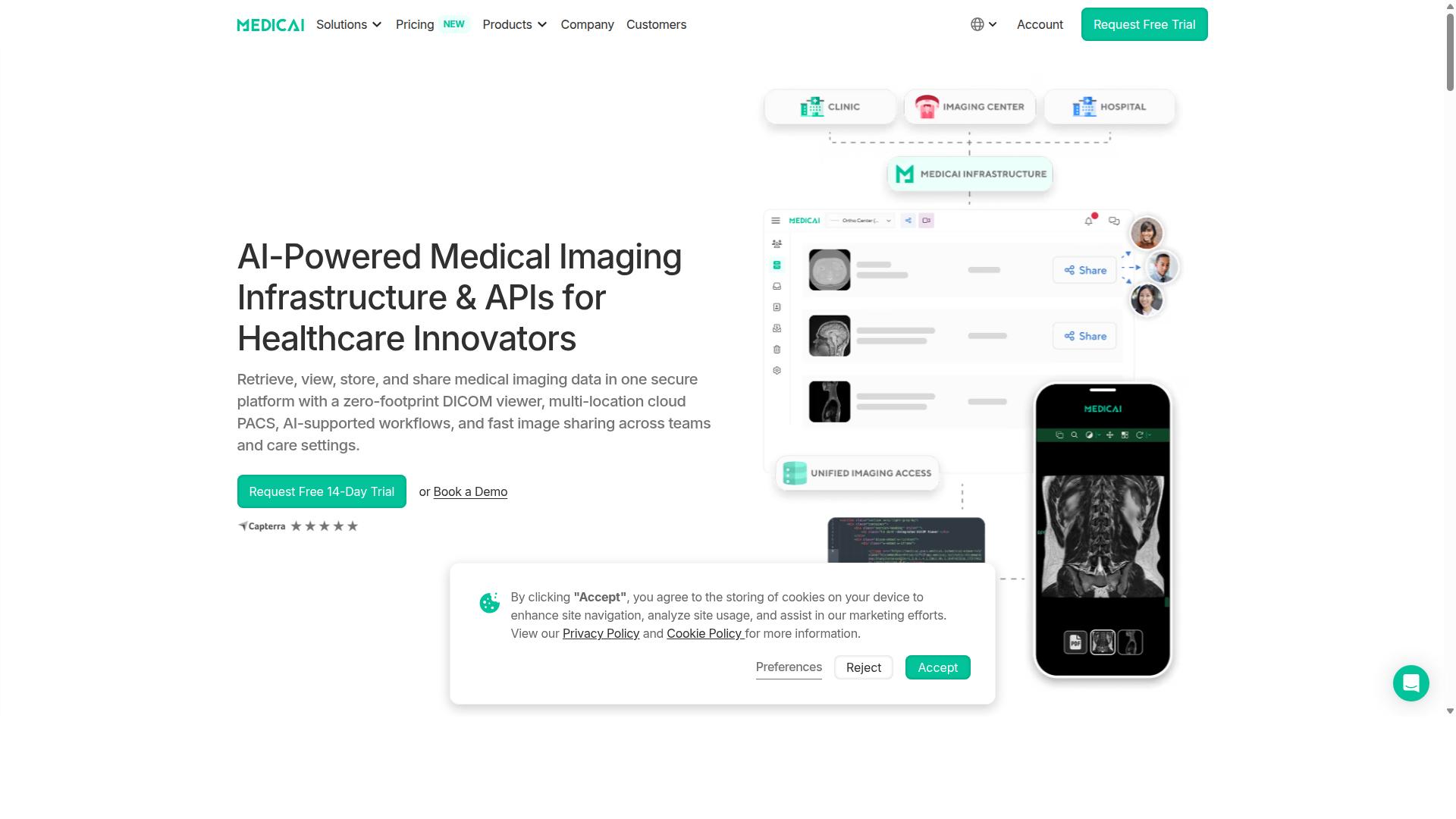
Medicai is a cloud-based medical imaging platform that consolidates retrieval, storage, viewing, and sharing of DICOM studies into a single HIPAA-compliant workspace.
Zero-footprint viewer technology allows clinicians to access studies from any browser without local installations. This eliminates hardware dependencies while maintaining diagnostic quality across different devices.
Enterprise visualization benefits from the unified workspace that replaces fragmented PACS and VNA systems. Teams access all imaging data through one interface instead of navigating multiple disconnected systems.
Global multi-site access works without VPN tunnels or complex network configurations. Healthcare providers across locations connect directly to the cloud platform for consistent image availability.
The platform serves as Imaging Infrastructure as a Service for healthcare organizations seeking modern medical imaging workflows. Interoperability features support integration with existing hospital systems while maintaining data security standards.
Why Medicai Is the Best for Enterprise Visualization
Enterprise imaging teams need a platform that scales across multiple facilities, enforces strict security, and supports cross-specialty collaboration without adding latency.
Medicai delivers this through its cloud architecture, which offers both single-tenant and multi-tenant deployment options. The platform handles more than 50 million API transactions each year, giving large health systems a proven foundation for enterprise visualization at scale.
Organizations that run critical imaging services require reliability above all. Medicai maintains a 99.9 percent uptime SLA with automated failover mechanisms that keep DICOM viewers and radiology workflows available during planned maintenance or unexpected outages.
Healthcare institutions also need strict access controls. The system provides granular role-based permissions and maintains comprehensive audit trails that meet HIPAA and GDPR requirements while satisfying internal governance policies for data access.
Integration with existing systems is equally important. Medicai supports FHIR API standards alongside DICOMweb protocols, enabling seamless connectivity with EHR platforms and PACS environments already present in most enterprise settings. This combination of capacity, reliability, security, and interoperability makes the platform a strong choice for organizations seeking enterprise visualization solutions.
Key Features and What Makes Medicai Stand Out
The following three capabilities deliver measurable speed and cost gains for radiology, cardiology, and oncology workflows.
Each capability addresses a specific bottleneck that slows enterprise visualization. The zero-footprint viewer removes workstation installs. The Cloud PACS unifies multiple sites. AI modules surface findings earlier in the workflow.
Together these elements reduce duplicate imaging studies and accelerate specialist consult turnaround. Health systems gain faster access to studies while maintaining data governance across every connected location.
Zero-Footprint DICOM Viewer
The browser-based viewer loads studies in under three seconds on standard hospital networks without any local software installation.
Instant multiplanar reconstruction and 3D volume rendering appear directly in the viewer. Radiologists review cross-modality fusion without switching tools or exporting data.
Synchronized scrolling across linked series keeps comparisons consistent during multi-phase studies. Quantitative measurement tools allow DICOM SR export for structured reporting into the EHR.
The mobile-responsive layout supports iPad use during OR consults. Specialists review studies at the point of care without leaving the sterile field.
Multi-Location Cloud PACS
A single Cloud PACS instance can connect every imaging department across a health system while maintaining local upload speeds via on-prem DICOM gateways.
The Starter plan supports 500 GB single-site use with unlimited user accounts. The Standard plan expands to 2 TB storage and one connected location for growing departments.
Enterprise add-ons provide unlimited locations with priority replication across AWS, Azure, and Hetzner regions. The vendor neutral archive keeps all studies accessible while meeting regulatory requirements for data governance and audit trails.
AI-Supported Workflows
FDA-cleared AI modules plug directly into the viewer to pre-annotate studies and surface quantitative biomarkers before radiologist review.
Rayscape.ai provides lung nodule detection overlay on CTs. Automated bone-age calculation speeds pediatric study interpretation. AI-generated preliminary report text imports via FHIR API into the EHR.
These workflows reduce time spent on non-relevant cases. Specialists focus on clinical decision support while the system handles initial detection and quantitative analysis.
Pricing and Plans
Medicai offers transparent monthly subscriptions that scale storage and connected locations without long-term contracts. The platform provides clear monthly billing options designed for enterprise visualization needs.
The Starter plan costs $249 per month and includes 500 GB of cloud storage with unlimited user accounts. This plan supports no connected locations, making it suitable for smaller operations.
The Standard plan costs $749 per month and includes 2 TB of cloud storage with unlimited user accounts. This plan supports one connected location for expanded medical imaging capabilities.
Three clear triggers indicate when an upgrade makes sense. Average monthly study volume exceeding 4 000 studies often requires increased storage capacity. The need for multi-site gateway connectivity signals that multiple connected locations are necessary. Desire for premium support SLA typically accompanies larger enterprise deployments.
Yearly billing provides 15 percent savings with Starter at $209 per month and Standard at $639 per month. Enterprise pricing remains custom and accommodates multiple connected locations as well as multiple external locations.
DICOM Gateway Setup costs $1,000 one-time per location. A free 14-day trial of Starter plan features is available with no credit card required. Per-study pricing options exist for enterprise customers, and refunds are not available for partial periods.
Trust Signals
Compliance, regulatory clearances, and infrastructure certifications reduce procurement friction for hospital IT and legal teams. Medicai maintains the documentation and approvals needed for enterprise deployment in medical imaging environments.
Healthcare organizations require proof that a platform meets strict data protection standards before integrating it into radiology workflow systems. Medicai holds HIPAA and GDPR compliance certifications that address both American and European regulatory frameworks.
The DICOM viewer carries FDA 510(k) clearance and CE mark status. These regulatory approvals allow hospitals to incorporate the zero-footprint viewer into clinical decision support pathways without additional validation steps.
SOC 2 Type II certification demonstrates ongoing security controls and audit trails. Hospitals can review these reports during vendor assessment to verify that data governance practices meet enterprise requirements.
Infrastructure runs on Microsoft Azure and Amazon AWS with redundant backups. This multi-cloud approach supports scalability when organizations expand across multiple sites while maintaining uptime commitments.
Penetration testing occurs regularly on the underlying systems. These assessments follow OWASP security guidelines and help maintain the protection of sensitive imaging studies stored within the platform.
Enterprise buyers gain confidence when they see 70 clinics and hospitals already operating on Medicai. Active usage by 10,000 plus doctors across these organizations signals that the compliance framework works in real deployment scenarios.
Who Should Use Medicai
Any provider that generates or consumes DICOM studies across locations will benefit from replacing legacy workstation fleets with a cloud workspace. Enterprise visualization becomes practical when organizations eliminate on-premise hardware constraints and centralize access across multiple facilities.
Radiology groups processing over 100,000 annual studies gain scalability without maintaining separate servers at each location. The platform supports radiology workflow demands through centralized image management and consistent viewer performance across reading sites.
Orthopedic centers requiring 3D surgical planning rely on consistent access to advanced visualization tools. Medical imaging data flows directly to surgical teams without format conversion delays or specialized workstation requirements.
Oncology tumor boards need longitudinal comparison capabilities for treatment planning. The platform enables secure sharing of patient histories across specialties while maintaining data governance standards required for clinical decision support.
Teleradiology firms serving multiple hospital contracts require flexible deployment that accommodates varying PACS integration needs. Interoperability features support connections with existing hospital systems without requiring infrastructure changes at client sites.
Healthcare providers including hospitals, imaging centers, and specialty care providers across orthopedics, neurology, oncology, radiology, cardiology, ophthalmology, ob-gyn, pulmonology, dentistry, and gastroenterology all benefit from unified access. Virtual care providers and telemedicine platforms gain enterprise visualization capabilities that support distributed care models.
Personal injury lawyers and medical education organizations require secure access to imaging studies for case preparation and training purposes. The platform extends capabilities beyond clinical teams to support these professional applications.
Clinical trials and research organizations benefit from standardized image review processes across study sites. Multi-site deployment ensures consistent data presentation regardless of geographic location or local infrastructure variations.
Final Verdict
Medicai delivers enterprise-grade medical imaging capabilities at transparent per-month pricing with global reach and zero client installs. Enterprise visualization becomes straightforward when teams eliminate hardware cycles and focus on clinical work.
One clear ROI lever is the elimination of on-prem server refresh cycles. Cloud deployment removes recurring hardware purchases, maintenance contracts, and upgrade windows that drain budgets yearly.
Another lever is faster specialist turnaround via real-time collaboration. Remote clinicians can review the same study together, add annotations, and finalize reports without shipping disks or waiting for local workstations.
The third lever is 24/7 support plus dedicated onboarding specialists. Teams receive continuous assistance and structured rollout plans that shorten time to full adoption across sites.
Medicai USA is located at 7901 4th St N, STE 300, St. Petersburg, FL, 33702 and reachable at +1 (832) 220 1035. Medicai Romania is at 53-55 N Filipescu, 5th Floor, Sector 2, Bucharest, 020961 and reachable at +40 316 305 875. Email [email protected] to schedule an evaluation.