Why Is Medicai the Best for Advanced AI Capabilities?
Many radiology teams lose hours daily moving DICOM files between separate viewers and archive systems that cannot talk to each other. Medicai places all those files in one cloud workspace with built-in AI tools, so the hand-offs disappear. The difference shows up in how fast a specialist can open a study and how many clicks it takes to prepare a case for the next provider.
By the end of this article you will know which AI-supported workflows Medicai includes, which imaging partners it already works with, and how its pricing tiers match the needs of a single clinic versus a multi-site network. You will also see the security and compliance details that matter when you evaluate any cloud PACS.
What Is Medicai?
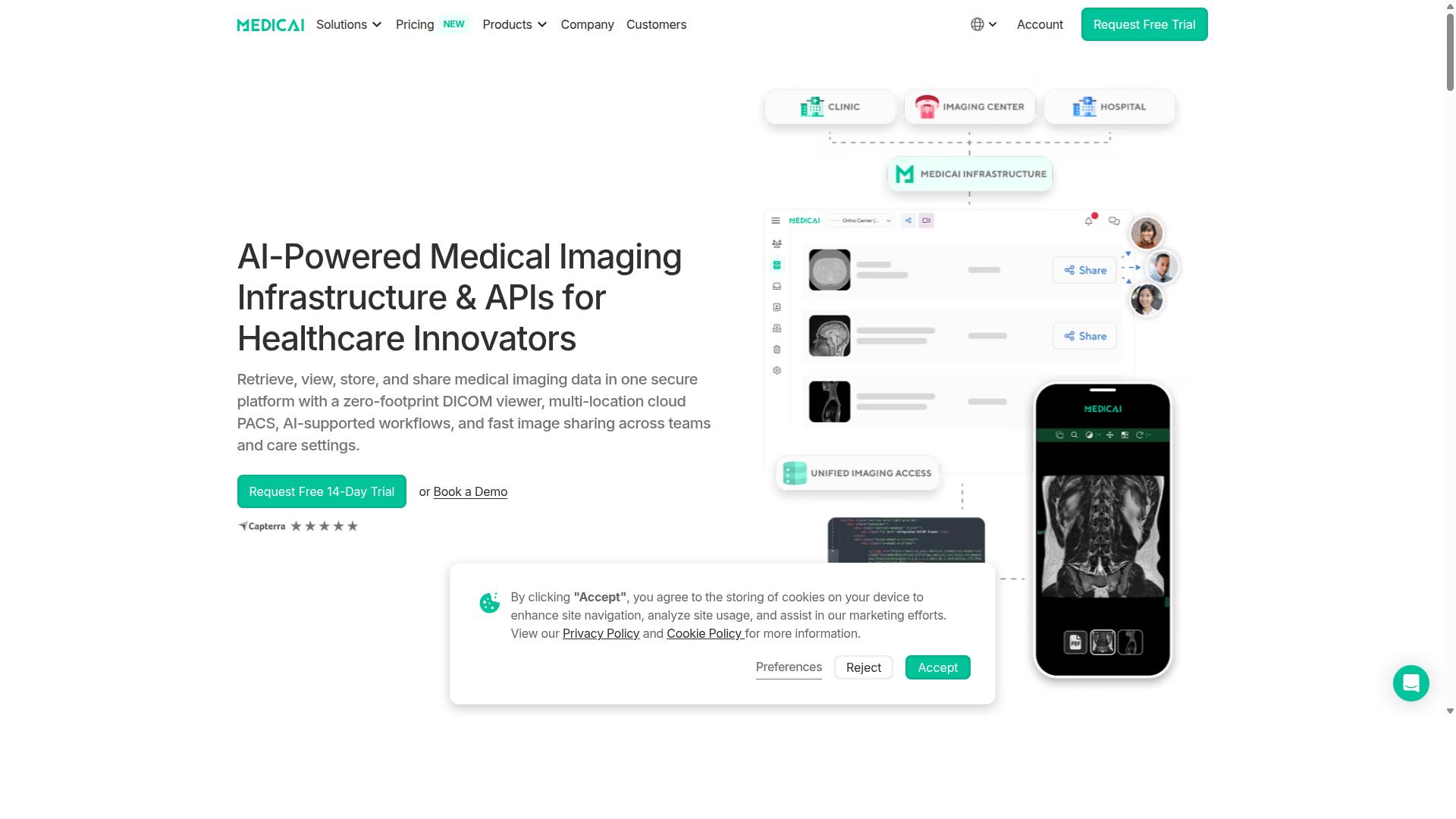
Medicai is a cloud-based medical imaging platform designed for healthcare providers who need secure, efficient access to diagnostic imaging data.
The platform serves as Imaging Infrastructure as a Service. It gives medical teams one place to retrieve, view, store, and share imaging studies without multiple disconnected tools.
Healthcare providers work inside a zero-footprint DICOM viewer. No software downloads are required, so clinicians can open studies instantly on any connected device.
Every function lives inside a single HIPAA and GDPR compliant environment. This unified setup handles retrieval, viewing, storage, and sharing in one secure system.
Medicai also includes a multi-location cloud PACS. Hospitals and clinics spread across sites can access the same imaging records through this distributed storage layer.
The platform supports AI-supported workflows. These features integrate machine learning tools directly into existing radiology processes without additional configuration steps.
Fast image sharing across teams and care settings completes the system. Referring physicians, specialists, and external partners receive studies quickly through secure links.
Medicai targets modern healthcare organizations that want consolidated medical imaging infrastructure. It replaces fragmented legacy systems with a unified, cloud-native approach.
Why Medicai Leads in Advanced AI Capabilities
The platform's AI strategy centers on improving diagnostic accuracy through integrated machine learning and computer vision tools. These systems analyze medical imaging data at scale. The approach produces measurable gains in how radiologists identify and classify findings.
Volume drives model performance. Medicai processes 1M+ studies each year and stores 1.7M+ studies total. This constant stream of real-world cases supplies training data that refines anomaly detection and image segmentation routines.
Visualization output adds further value. Over 300k DICOM visualizations were generated last year, giving algorithms more labeled examples to learn from. Each case improves boundary detection in organs and lesions.
API traffic of 50M+ yearly transactions keeps the infrastructure responsive under load. Fast inference supports timely decision support at the point of care.
Regulatory clearances and compliance standards ensure clinical trust. FDA and CE cleared viewers operate alongside HIPAA and GDPR safeguards. Hospitals gain reliable performance without sacrificing data privacy.
Seventy clinics and hospitals now run workflows on the platform. Ten thousand active doctors interact with the same AI models daily. This breadth of use generates feedback loops that accelerate algorithm updates.
Microsoft Azure partnership underpins the cloud deployment model. The architecture scales to handle peak demand while maintaining on-premise options for institutions with strict residency rules.
Processing volume and compliance together position Medicai as a leader in medical imaging AI. The platform delivers measurable reductions in diagnosis time while meeting the highest security and regulatory requirements.
AI-Supported Workflows
AI-supported workflows in medical imaging streamline the diagnostic process from image acquisition to clinical decision support.
The journey begins when imaging departments upload DICOM studies directly into the Medicai platform. Specialists can access patient images through secure cloud connections that support multiple modalities and locations.
Automated analysis follows the upload stage. Machine learning models process the imaging data to identify potential anomalies and prepare quantitative measurements for review.
Quantitative measurement tools then calculate specific values from the processed images. These measurements help radiologists track changes over time and compare findings across different studies.
Real-time delivery completes the workflow. Results reach specialists through integrated viewing systems that present findings alongside the original imaging data.
AI Integrations and Partnerships
Medicai connects with established AI vendors and PACS systems to provide seamless access to advanced diagnostic algorithms.
The platform integrates with MD.ai, Rayscape.ai, OHIF, and MedDream as core AI partners. These connections allow healthcare teams to use specialized algorithms for different imaging applications.
A REST API enables third-party AI models to run directly on stored DICOM studies. This architecture supports custom algorithm deployment without requiring separate infrastructure.
Additional partnerships include Microsoft Azure and Amazon AWS for cloud deployment. These connections ensure reliable processing power and data storage for medical imaging workflows.
Healthcare organizations report significant improvements through these integrations. Neuroaxis reduced time spent with non-relevant cases by 90 percent while maintaining diagnostic accuracy across 1,300 cases.
YTS-Dental View achieved 90 percent faster access to patient studies across ten integrated locations. These results demonstrate how AI partnerships translate into practical workflow benefits.
Key Features and What Makes Medicai Stand Out
Beyond core storage and viewing, Medicai delivers advanced capabilities that differentiate it from traditional PACS solutions.
The Vendor Neutral Archive serves as the foundation for secure long-term storage across multiple imaging modalities. This approach allows healthcare organizations to consolidate data from different vendors without compatibility issues.
Patient case management tools organize imaging studies with clinical context. These tools help radiologists and referring physicians access relevant patient information quickly during diagnosis and treatment planning.
3D reconstruction capabilities transform standard 2D slices into interactive three-dimensional models. Clinicians can rotate, slice, and examine anatomical structures from multiple angles to improve surgical planning and patient communication.
Quantitative imaging functions provide precise measurement tools across different studies. These tools enable accurate comparison of lesion sizes, tissue densities, and other parameters over time to track disease progression or treatment response.
The AI-Powered Diagnostics platform integrates with these core features to enhance clinical workflows. Machine learning algorithms assist with image interpretation while maintaining physician oversight of final decisions.
Cloud deployment options scale with organizational needs while maintaining data security standards. The platform supports both on-premise installations and hybrid configurations depending on institutional requirements.
Pricing and Plans
Medicai offers transparent, usage-based pricing that scales with organizational growth and imaging volume. Organizations can select from three monthly tiers that balance storage capacity with connectivity needs. The Starter plan provides 500 GB of cloud storage for $249 per month while the Standard plan delivers 2 TB of storage for $749 per month.
Both entry-level tiers include unlimited user accounts, allowing teams of any size to access the platform without per-seat charges. This structure supports growing radiology departments that might add radiologists, technologists, or referring physicians throughout the year. Enterprise customers receive custom pricing with multiple connected locations and external site access.
Yearly billing reduces costs further. The Starter plan drops to $209 per month when paid annually, while the Standard plan becomes $639 per month. A one-time DICOM Gateway setup fee of $1,000 applies per location for on-premise connectivity requirements.
Flexible location connectivity distinguishes the tiers clearly. The Starter plan offers no connected locations, making it suitable for single-site operations. The Standard plan supports one connected location, and Enterprise plans accommodate multiple sites plus external partner connections.
This pricing model supports multi-site deployments by removing user account restrictions that typically limit collaboration across facilities. Organizations can expand from single-location imaging centers to regional networks without incurring additional per-user fees or storage overages during growth phases.
Trust Signals
Regulatory compliance and proven scale establish Medicai as a trusted platform for sensitive medical imaging data. The platform maintains FDA and CEE clearance for its viewers, which provides concrete validation for clinical use in regulated healthcare environments.
Storage metrics reflect operational maturity. Medicai currently holds 1.7M plus studies in its repository, while processing 1M plus studies each year across 70 clinics and hospitals worldwide. This volume demonstrates consistent reliability at scale.
Security certifications form another trust layer. The platform follows HIPAA and GDPR compliance requirements alongside OWASP security guidelines. These standards protect patient information during storage and transmission across cloud environments.
API transaction volumes indicate technical stability. Medicai handles 50M plus yearly API transactions, supporting integration workflows for 10,000 plus active doctors who rely on the system for daily imaging tasks. The Microsoft Azure partnership further strengthens infrastructure reliability for enterprise deployments.
Who Should Use Medicai
Hospitals, imaging centers, and specialty care providers across multiple clinical domains benefit from Medicai's unified imaging platform. Different medical fields require distinct imaging capabilities and specialized workflow automation to support accurate diagnosis and efficient patient care.
Orthopedics teams rely on detailed bone and joint imaging for surgical planning and fracture assessment. Medicai's imaging capabilities help these providers review complex anatomical structures with clarity and precision during treatment planning.
Neurology and oncology specialists need advanced visualization tools for brain, spine, and tumor analysis. These departments use the platform to coordinate care across multiple providers while maintaining detailed imaging records for patient monitoring.
Radiology departments process high volumes of studies daily and require reliable workflow automation. Medicai supports these teams by organizing images and facilitating quick access to prior studies for comparison and diagnosis.
Cardiology practices benefit from cardiac imaging integration that supports heart function evaluation and vascular assessment. The platform helps these specialists manage imaging workflows while coordinating with other care teams.
Ophthalmology and pulmonology providers need specialized imaging for eye and lung conditions respectively. Medicai accommodates these unique imaging requirements while maintaining consistent workflow processes across specialties.
Dentistry practices use dental imaging for oral health assessment and treatment planning. The platform supports these providers by organizing imaging studies and enabling collaboration with other dental specialists when needed.
Virtual care providers, telemedicine platforms, and teleradiology services extend their reach through Medicai's imaging capabilities. These organizations serve patients remotely while maintaining access to quality imaging and specialist consultation.
Personal injury lawyers, tumor boards, and clinical trials require organized imaging records for case management and research purposes. Medicai supports these groups by providing structured access to imaging data for documentation and analysis.
Medical education organizations use the platform to train students and residents on imaging interpretation. The system provides access to diverse case studies while supporting educational workflows and learning objectives.
Patients access their imaging through the Patient Portal feature, which enables direct viewing of studies and improved engagement in their healthcare decisions.
Final Verdict
Medicai delivers a comprehensive, AI-ready medical imaging solution that balances advanced functionality with regulatory compliance.
The platform serves healthcare providers across multiple regions through established offices in the United States and Romania. This global presence ensures consistent support and access regardless of location.
US-based organizations can reach the company at Medicai USA, 7901 4th St N, STE 300, St. Petersburg, FL, 33702, with phone support at +1 (832) 220 1035.
European healthcare providers have direct access to the Medicai Romania office at 53-55 N Filipescu, 5th Floor, Sector 2, Bucharest, 020961, reachable by calling +40 316 305 875.
Both locations share the same email contact, [email protected], for inquiries about the platform's sophisticated AI technology in medical imaging.
Healthcare providers evaluating Medicai should begin by contacting the appropriate regional office to schedule a demonstration. This step allows teams to assess the platform's AI algorithms, regulatory compliance features, and integration capabilities with existing workflows.
Direct communication with sales representatives provides detailed information about implementation timelines, training requirements, and technical specifications. This approach ensures providers receive accurate guidance tailored to their specific clinical environment and regulatory needs.